


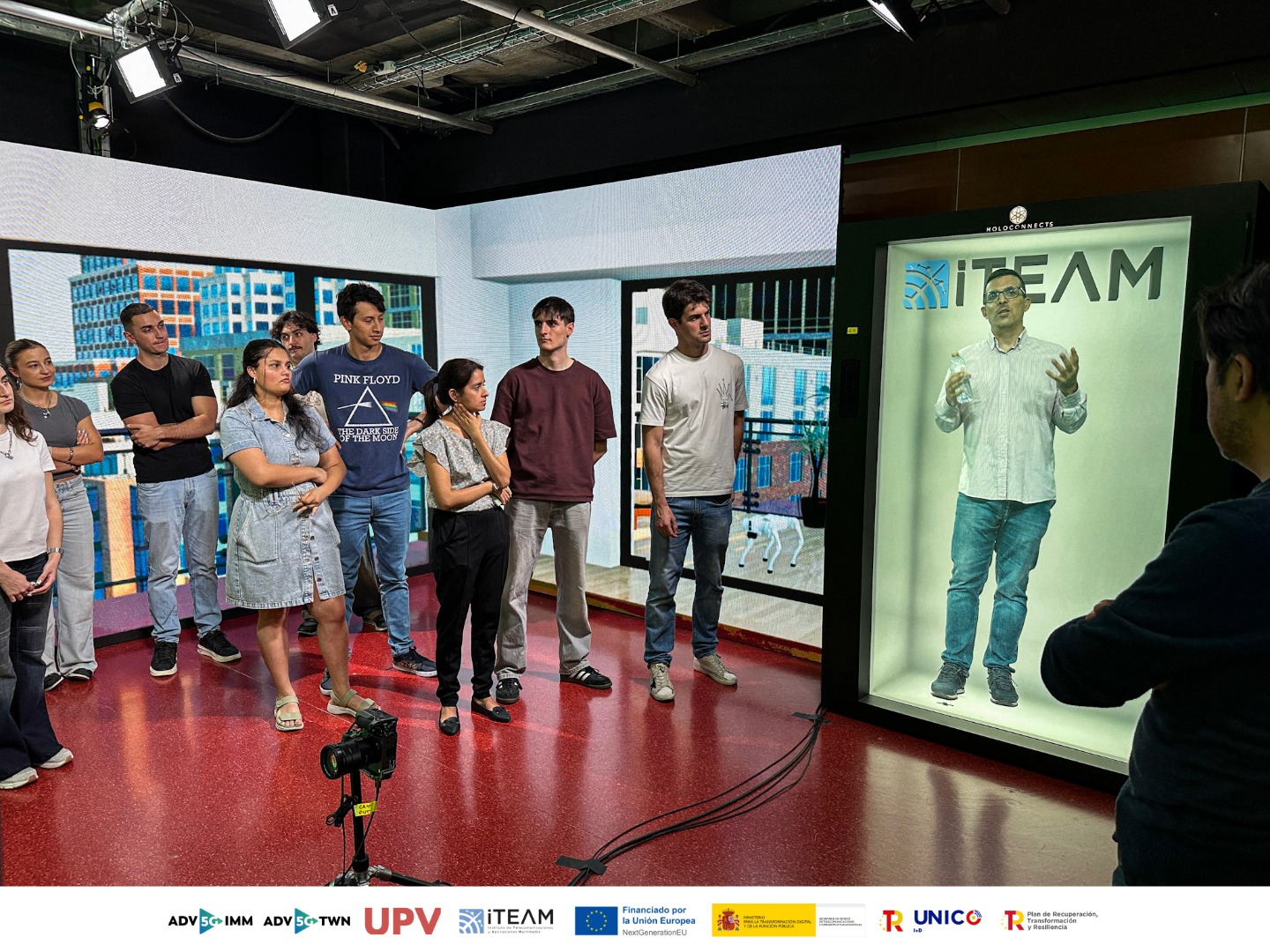
During the week of October 13–17, the laboratory —part of the Mobile Communications Group (MCG)— welcomed up to 120 students from various undergraduate and master’s programs at the Universitat Politècnica de València (UPV), as well as from the Bachelor’s Degree in Engineering and Business Management at the School of Entrepreneurs (EDEM). In addition, the Councillor for Energy Transition, Industry, and Culture of the Alcoy City Council, Elisa Guillem de la Cruz, together with her team, had the opportunity to see first-hand the laboratory’s capabilities and the opportunities it offers for the development of institutional and business projects based on advanced technology within the technological sector.
The Immersive Communications Laboratory is a unique space in the city of Valencia where students can experiment and work with the most advanced immersive communication technologies even before completing their studies. Among its facilities are an immersive digital production studio, extended reality (XR) environments, collaborative robotics systems, and the first private 5G network installed at a public university in Spain.
Beyond its role in teaching and training, the laboratory functions as an open technological testbed for institutions and companies wishing to test solutions or prototypes in a secure environment, supported by UPV’s research team and student talent.
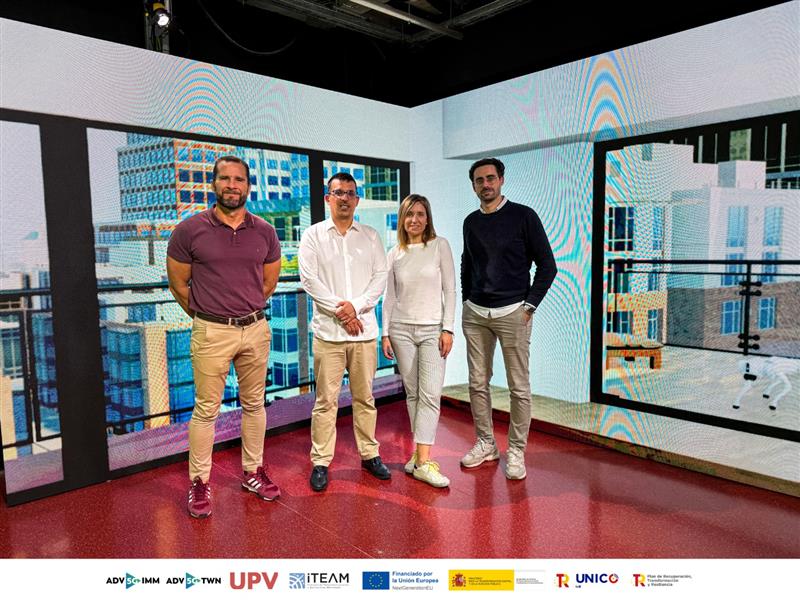
During the visits, attendees had the opportunity to participate in various interactive demonstrations designed by the laboratory team, including Mixed Reality experiences, holography, and telepresence — offering a direct immersion into the future of communications.
These activities strengthen the commitment of iTEAM and the Mobile Communications Group to educational innovation, knowledge transfer, and collaboration with the business and institutional ecosystem of the Valencian Community.
The Laboratory is part of the Program for the Universalization of Digital Infrastructures for Cohesion (UNICO)within the Recovery, Transformation, and Resilience Plan, funded by the Ministry for Digital Transformation and Civil Service with European Union – NextGenerationEU funds (TSI-063000-2021-109, TSI-063000-2021-110, TSI-063000-2021-111, TSI-063000-2021-112, TSI-063000-2021-113, TSI-063000-2021-114).